The Gothic Quarter, the Montjuïc Castle, Spain wins the World Cup!
The Gothic Quarter: Walking Through Old Barcelona
Known locally as the Barri Gòtic, the Gothic Quarter forms part of Barcelona’s historic center and is one of the oldest areas of the city. Its narrow streets, hidden courtyards, stone buildings and small plazas can make it feel as though you’ve stepped into medieval Europe—but the neighborhood’s history stretches back even further.
Long before Barcelona became the city we know today, this area was the heart of the Roman settlement of Barcino, founded more than two thousand years ago. Remnants of the Roman city can still be found throughout the neighborhood, including sections of ancient walls and archaeological remains incorporated into later buildings.
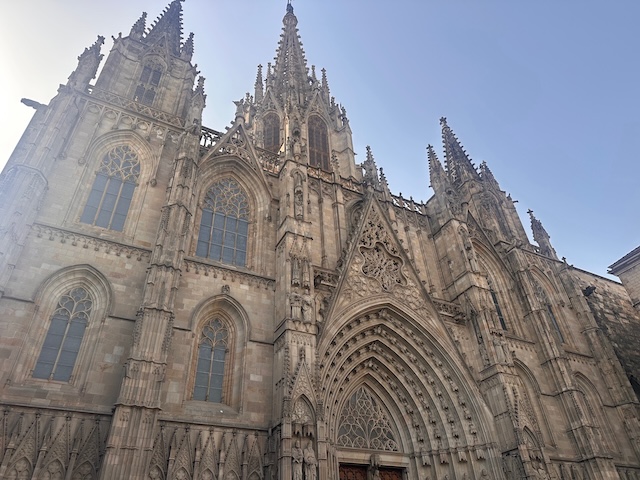
At the center of the district stands the Barcelona Cathedral, officially the Cathedral of the Holy Cross and Saint Eulalia. With its soaring Gothic architecture, cloisters and elaborate stonework, it is one of the neighborhood’s most recognizable landmarks and a reminder of the influence the Church held in medieval Barcelona.
Nearby, Plaça del Rei preserves one of the most atmospheric corners of the old city. Surrounded by medieval buildings once associated with Barcelona’s counts and kings, the square feels remarkably removed from the modern city just beyond its walls.
But part of the appeal of the Gothic Quarter isn’t any single monument. It’s the experience of wandering through it. The streets twist unexpectedly, opening into quiet plazas, cafés, shops and centuries-old buildings before narrowing again into stone passageways. Modern Barcelona is constantly present—restaurants, residents, boutiques and crowds of visitors all fill the neighborhood—but the past never feels very far away.
That mixture is part of what makes the Gothic Quarter so memorable. Roman ruins, medieval architecture and modern city life all occupy the same few blocks.
A Hidden Mystery Beneath the Bishop’s Bridge
One of the most recognizable sights tucked into the narrow streets of the Gothic Quarter is the Pont del Bisbe, or Bishop’s Bridge—a beautifully ornate bridge stretching between two buildings above Carrer del Bisbe.
At first glance, it looks as though it has been hanging over this medieval street for centuries.
Surprisingly, it hasn’t.
The bridge was actually built in 1928 by architect Joan Rubió i Bellver, a disciple of Antoni Gaudí, who designed it in a neo-Gothic style intended to blend with the historic buildings surrounding it.
But the really interesting part is underneath.
Looking up from the street reveals an elaborate vaulted ceiling covered with symbolic carvings. Among them is something decidedly strange: a skull pierced by a dagger.
No one seems to know for certain what Rubió intended the skull to represent, but Barcelona has naturally filled that void with a few legends of its own.
According to one, removing the dagger from the skull would somehow bring about the destruction of Barcelona. Another is a little more useful to visitors: walk backward beneath the bridge while keeping your eyes on the skull, make a wish, and the wish will supposedly come true.
We weren’t entirely sure how much faith to put in the legend—but when you’re standing beneath a mysterious skull in a centuries-old-looking alleyway in Barcelona’s Gothic Quarter, it seems like the sort of tradition you might as well participate in.
And it was one more reminder that in the Gothic Quarter, some of the most interesting things aren’t necessarily the landmarks you’re looking for.
Sometimes you have to remember to look up.
Els Quatre Gats (The 4 Cats)/Els Quatre Gats: Where a Young Picasso Got His Start
Els Quatre Gats was the site of Pablo Picasso’s first solo exhibition, held in February 1900, when he was only 18 years old. The Museu Picasso in Barcelona specifically identifies the show as his first solo exhibition; another of the museum’s historical resources describes it as his first public exhibition.
It was essentially one of the headquarters of Barcelona’s artistic counterculture at the dawn of the 20th century — which makes it a perfect addition to the story you’re building about the city.
Els Quatre Gats — Catalan for “The Four Cats” — opened in 1897 on the ground floor of Casa Martí, a Modernista building designed by architect Josep Puig i Cadafalch. Pere Romeu opened it with artists Santiago Rusiñol, Ramon Casas and Miquel Utrillo, deliberately modeling it after the famous Le Chat Noir cabaret in Paris.
Tucked away among the narrow streets of Barcelona’s old city is a place that, at first glance, might seem like just another historic European café.
Els Quatre Gats — “The Four Cats” — was anything but.
Opened in 1897 inside the Modernista Casa Martí, Els Quatre Gats became a gathering place for Barcelona’s artists, writers and intellectuals at the turn of the 20th century. Inspired by the famous Le Chat Noir cabaret in Paris, it became one of the centers of Barcelona’s emerging avant-garde art scene.
Among the young artists who found his way through its doors was an 18-year-old Pablo Picasso.
In February 1900, Picasso held his first solo exhibition here, filling the room with approximately one hundred portraits along with several paintings. The exhibition helped introduce the young artist to Barcelona’s artistic community — decades before the name Picasso would become known throughout the world.
Picasso became closely associated with the café and the circle of artists who gathered there, and he would even create artwork for one of the restaurant’s menus.
Today, knowing what happened here makes walking past Els Quatre Gats feel a little different.
Before Picasso was Picasso, he was a teenage artist hanging his drawings on the walls of a café in Barcelona.
Montjuïc Castle: Watching Over Barcelona
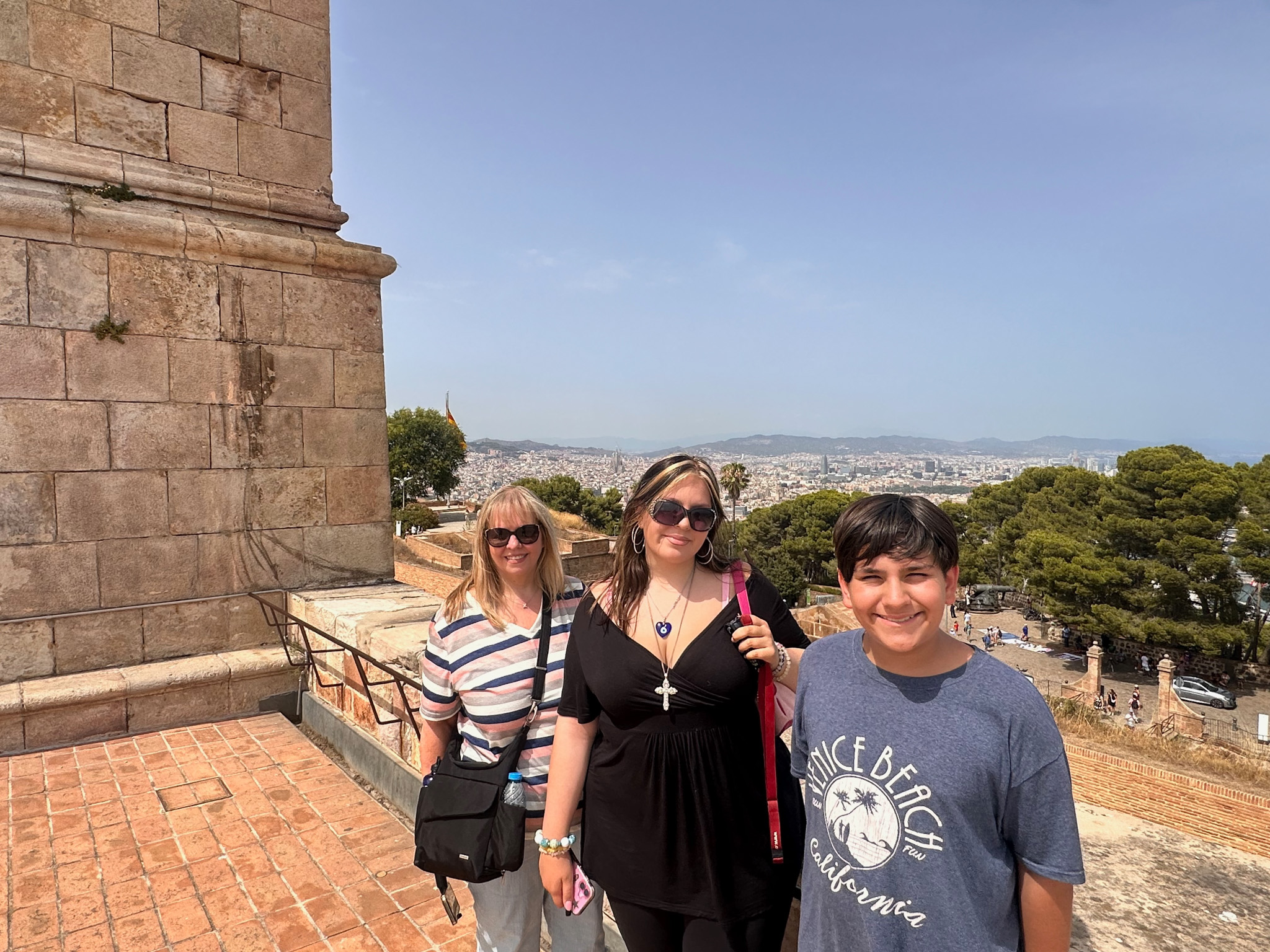
Our trip to the top of Montjuïc began with the cable car, slowly carrying us above the hillside as Barcelona and the Mediterranean opened up below us. At the summit sits Montjuïc Castle, and while the views alone make the trip worthwhile, the fortress has a much more complicated story than we initially realized.
The first fortification here was constructed in 1640, during the Catalan Revolt, taking advantage of a location that had probably been used for watching the sea long before soldiers arrived. The castle that stands here today is largely the product of an 18th-century reconstruction, designed as a formidable military fortress overlooking Barcelona and its harbor.
Standing on the ramparts makes its strategic importance immediately obvious.
From Montjuïc, you can see across the Mediterranean, directly into Barcelona’s port and far across the city itself. Whoever controlled this hill held an extraordinary position from which to defend Barcelona.
Or, as history would demonstrate, to control it.
During periods of unrest in the 19th century, the cannons of Montjuïc were turned toward the city below, and Barcelona was bombarded from the fortress on several occasions. The castle would later serve as a prison for political prisoners, labor activists, revolutionaries and others who came into conflict with the governments of their time.
Perhaps the castle’s most haunting chapter came in 1940, when Lluís Companys, president of Catalonia’s Generalitat, was executed here after being captured in German-occupied France and turned over to Francisco Franco’s government.
But hidden among all that military and political history is a completely unexpected connection to something we use every day.
In the 1790s, French astronomer Pierre Méchain used Montjuïc as one of his surveying points while measuring the Earth’s meridian. Those measurements became part of the work used to establish a new universal unit of length.
The meter.
Suddenly the old watchtower at the top of the castle wasn’t simply another piece of a military fortress—it was connected to the creation of the metric system used around most of the world today.
Walking around Montjuïc Castle, then, is really a walk through several very different versions of Barcelona’s history: a city defending itself, a city being controlled, a city struggling with political conflict, and even a city playing a small part in the history of science.
And all of it unfolds against one of the best views of Barcelona we encountered during our visit.
A BSA Rendezvous While Feeding the Pigeons
A Gaudi-inspired McDonald’s
at Ronda de Sant Pere, 3 (near Plaça de Catalunya)
World Cup – Spain wins
Leave a Reply
You must be logged in to post a comment.